
Male Collage
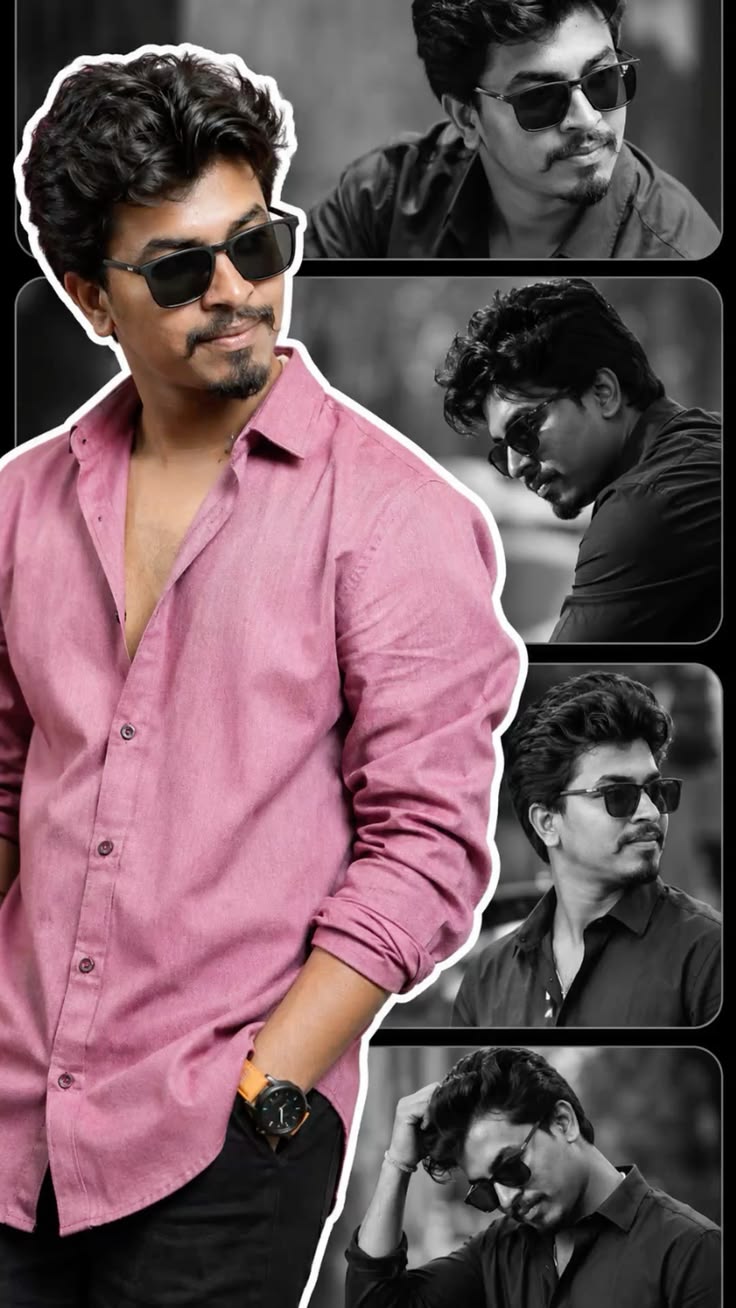
Male Collage presents five views of one male identity in a modern editorial poster. A selective-color hero leads four monochrome portraits, creating a realistic, layered, polished vertical wallpaper.Male Collage
Creative Male Collage Composition and Visual Direction
Male Collage uses a dense vertical arrangement. The large standing figure dominates the left and center, while four rounded grayscale panels form a clear stack on the right. Thin black gaps separate each frame, preserving readability and a unified poster rhythm.Male Collage
Male Collage keeps the hero figure in front of every supporting panel. The body starts near the upper-left and continues toward the bottom, overlapping the left edges of the grayscale images. This hierarchy gives the color subject immediate visual priority.Male Collage
A thick white sticker contour defines Male Collage and cleanly separates the vivid foreground from the dark panel stack. The border follows hair, sunglasses, shoulders, sleeves, hands, shirt, and body edges with smooth precision, adding graphic impact without losing photographic realism.
The fashion identity of Male Collage comes from a dusty rose pink button-down shirt, black trousers, dark rectangular sunglasses, and a round watch with a warm strap detail. Open buttons, collar folds, button lines, wrinkles, and sleeve creases make the outfit believable.
Identity consistency is essential in Male Collage. All five faces show the same person while preserving unique head angles, gazes, expressions, and crops. Facial proportions, hairline, hairstyle, skin tone, age impression, jaw, nose, lips, and natural body build remain stable.
The hero pose gives Male Collage relaxed confidence. The torso turns slightly right, one hand rests deeply in a trouser pocket, and the other arm hangs naturally. The head turns upward-right behind sunglasses, with a subtle closed-mouth smile and a natural waist-to-thigh crop.
The top-right panel changes the pace of Male Collage through a monochrome bust view. One shoulder sits closer to the camera, the head turns strongly right, and the side gaze remains calm. Its tighter crop contrasts with the standing figure without becoming an extreme close-up.
The next panel makes Male Collage more expressive with a forward lean. The torso angles diagonally, shoulders respond naturally to the posture, and the lowered head turns left. A serious downward gaze distinguishes this view from the confident smile of the foreground subject.
Why Male Collage Creates a Powerful Cinematic Poster
In the smaller lower panel, Male Collage returns to an upright bust pose with a new directional balance. The torso angles left while the head turns right and the chin rises gently. A smaller face scale and mild confident expression protect the intended hierarchy.
The bottom-right view completes Male Collage with a raised elbow and hand contacting the top or back of the hair. The head tilts down toward the left and the opposite shoulder sits lower. This introspective gesture prevents the five-view design from feeling duplicated.
Lighting gives Male Collage its glossy magazine finish. Luminous highlights shape the forehead, cheeks, nose bridge, lips, jaw, and neck. Hair shine, bright sunglass reflections, soft shirt highlights, radiant edge light, visible bloom, and gentle haze increase cinematic depth.
The supporting images keep Male Collage dramatic through true grayscale treatment. Deep blacks, bright facial highlights, silver-gray midtones, crisp sunglasses, hair waves, and illuminated shirt folds create separation. Soft monochrome bokeh adds depth with no accidental color leakage.
Color control makes Male Collage memorable. The shirt remains rich dusty pink rather than red, purple, faded, or muddy. Warm natural skin, black accessories, glossy dark hair, bright white contour, luminous highlights, and vivid realistic saturation create a strong selective-color effect.
The framing of Male Collage stays naturally zoomed out. The head never becomes oversized, and shoulder width, arm size, torso scale, waist feel, and height impression remain believable. Visible pocket contact, watch placement, waist, and upper legs support the fashion narrative.
The expected result of Male Collage is a dense, high-contrast poster with five clearly separated views of one person. No extra figure, missing panel, repeated pose, pasted face, or colored grayscale panel should interrupt the concept. Every layer feels separately photographed yet visually connected.
Male Collage works best with strong but controlled glow and contrast. Highlights stay visible, whites remain clean, shadows retain depth, and skin avoids excessive smoothing. Crisp foreground edges against smooth panel bokeh create professional separation and atmospheric depth.
Ultimately, Male Collage delivers a cinematic editorial poster with five views, selective pink color, grayscale panels, white contour, unique poses, rich highlights, and natural proportions. The result feels modern and powerful.
[[[ Exact Reference Reading
Reference posture: mixed — standing + leaning/seated portrait variations. The dominant foreground character is standing in a relaxed three-quarter pose, torso angled slightly toward the right side of the canvas, one hand placed inside the trouser pocket, opposite arm hanging naturally, shoulder line relaxed, and head turned toward the upper-right with a subtle confident smile.
Evidence: visible upright torso, pocket contact, long shirt drape, waist-to-thigh crop, and balanced standing body support. The four monochrome background portraits use separate upper-body leaning, seated/forward-bent, upright side-looking, and hand-on-hair postures, each with a different head angle, gaze, crop, and arm placement.
Exact ratio and canvas: vertical portrait poster, approximately 9:16, tall mobile wallpaper composition. Preserve the exact narrow vertical canvas, full poster framing, subject scale, margins, panel dimensions, and crop. Camera must remain naturally zoomed out like the reference; do not enlarge the main face or body and do not create an extreme close-up.
Reconstruction Objective
Recreate the MAIN REFERENCE as an exact identity-replaced photographic collage poster, preserving the same five visible portraits, exact placement, subject scale, pose geometry, crop points, overlapping layers, black-and-white side panel arrangement, pink selective-color foreground portrait, thin black canvas gaps, rounded rectangular panel corners, white sticker-cutout outline, camera perspective, background blur, contrast, texture, and photographic medium.
Use the uploaded PERSON SOURCE only for identity and natural body identity.
Preserve the uploaded person’s real facial identity with maximum face accuracy. Replace the reference face completely with the uploaded person while keeping exact facial proportions, eye shape and spacing, nose shape, lips, jawline, chin, cheek structure, forehead, head shape, hairline, hairstyle, beard status, skin tone, age impression, and body identity.
Never paste a raw selfie face. Rebuild the uploaded person’s identity separately in every portrait using that portrait’s exact head angle, gaze, expression, shadow direction, monochrome treatment, sharpness, depth of field, and camera perspective from MAIN REFERENCE. Preserve PERSON SOURCE natural shoulder width, arm size, torso size, waist feel, height feel, and natural build; never make the person slimmer, taller, muscular, model-like, older, or physically different.
Character Position Map
Exact visible character/portrait count: 5 copies of the same mapped identity only. No extra portrait, no missing portrait.
1. Main foreground portrait — left and center dominant layer: largest character, occupying almost the full height from upper-left hair area to bottom edge. Body begins near the left canvas edge and extends across center, overlapping the right portrait panels. Large standing three-quarter body crop, head in upper-left/upper-middle region, torso centered-left, lower body continuing toward the bottom. Keep the exact large scale but maintain the same natural zoomed-out framing.
2. Top-right portrait: wide horizontal rounded rectangular monochrome panel in the upper-right background, behind the main cutout. Upper bust close-up, head near upper-center-right, shoulders extending toward right edge.
3. Middle-right upper portrait: large horizontal/near-square rounded monochrome panel directly below the top panel. Positioned center-right, partly hidden by the dominant foreground body. Forward-leaning upper-body portrait with face near upper-left portion of its visible panel and torso/arm extending diagonally toward lower-right.
4. Lower-middle-right portrait: smaller horizontal rounded monochrome panel beneath portrait 3. Upright upper-bust portrait, face toward the upper-right side of the panel, body cropped by the foreground cutout on the left.
5. Bottom-right portrait: horizontal rounded monochrome panel at the bottom-right. Upper-body portrait with one arm raised and hand contacting the hair/head. Lower part cropped naturally by the bottom canvas edge.
Preserve exact foreground/background hierarchy: portraits 2–5 remain behind the main foreground cutout; main portrait overlaps and partially hides their left areas. Keep thin black spacing between all panels and exact rounded corners.
Reference Pose Map
1. Main foreground portrait: relaxed standing three-quarter pose; body angled slightly toward screen-right; one hand deeply inside the trouser pocket; opposite arm relaxed beside the body; shoulders naturally uneven; open shirt neckline; head turned toward upper-right; chin slightly lifted; eyes directed sideways behind dark sunglasses; subtle confident closed-mouth smile. Large three-quarter body crop with visible torso, waist, upper legs, wristwatch, and pocket contact.
2. Top-right portrait: upper-bust close-up; torso angled diagonally; shoulder closer to camera; head turned strongly toward screen-right; chin nearly level; side gaze behind sunglasses; calm, composed expression; no hand visible; distinctly different crop and body angle from portrait 1.
3. Middle-right upper portrait: leaning or seated-forward posture; torso bent forward and angled diagonally toward lower-right; shoulders curved slightly from the lean; head tilted downward and toward screen-left; chin lowered; gaze down behind sunglasses; serious contemplative expression; visible arm/torso support cues. Do not make this portrait upright or smiling.
4. Lower-middle-right portrait: upright upper-bust pose; torso slightly angled toward screen-left while head turns toward screen-right; chin gently raised; sideways gaze; mild confident expression; arms mostly outside the crop. Keep a smaller face scale and tighter panel crop than the main portrait.
5. Bottom-right portrait: relaxed leaning upper-body pose; one elbow bent upward; hand placed into or over the hair at the top/back of the head; head tilted downward toward screen-left; sunglasses slightly angled with the head; introspective expression; opposite shoulder lower. Preserve exact raised-arm silhouette and hand-to-hair contact.
Every copy must retain its own unique pose, view, angle, crop, expression, gaze, hand placement, body angle, and scale exactly as mapped above. Never repeat the main standing pose in the four background panels and never copy PERSON SOURCE pose.
Style and Medium
High-quality modern editorial male photography collage / stylish social-media portrait poster, realistic photographic face and body, crisp foreground cutout, selective-color hero portrait, dramatic monochrome supporting portraits, smooth professional retouching, shallow depth of field, soft urban outdoor bokeh, glossy magazine-poster finish, rich tonal separation, clean edges, and dense layered composition.
The main portrait remains in vivid selective color. All four right-side panels remain true black-and-white / grayscale with deep blacks, clean whites, smooth midtones, and cinematic contrast.
Outfit and Accessories Lock
Use only the MAIN REFERENCE outfit styling.
Main foreground portrait: dusty rose / muted vivid pink long-sleeve button-down shirt, soft cotton-linen texture, relaxed fit following the PERSON SOURCE natural body build, open upper buttons creating a deep casual neckline, natural collar folds, visible vertical button line, realistic wrinkles around chest, waist, elbows, and rolled/pushed sleeve areas. Black trousers. Dark rectangular sunglasses. Dark round wristwatch with warm brown/orange strap detail on the pocket-side wrist.
All four monochrome portraits: dark/black collared shirt with natural folds and subtle sheen, dark rectangular sunglasses. Preserve facial hair only according to PERSON SOURCE identity, not the reference model.
Scene and Background Lock
Keep the poster background predominantly black with four stacked right-side photographic panels. Each panel contains softly blurred grayscale outdoor/urban bokeh with indistinct foliage or street-like tonal shapes. Preserve soft circles of blur, shallow depth, panel-by-panel background softness, thin dark separators, and rounded panel borders.
The main foreground character must have a thick clean white sticker-style contour outline following the exact hair, sunglasses, shoulder, arms, shirt, and body silhouette. The white border must clearly separate the color portrait from the grayscale panels. Preserve consistent outline thickness and smooth cutout quality.
Do not use PERSON SOURCE clothing, room, wall, selfie background, camera angle, or lighting.
Lighting, Glow and Highlight Zones
Use strong cinematic glow, visible bloom, radiant rim light, glowing backlight, luminous highlights, and soft atmospheric haze, adapted to this high-contrast editorial reference without destroying its monochrome collage design.
Main portrait: luminous natural face highlights across forehead, upper cheeks, nose bridge, lips, jaw edges, and neck; glossy hair shine concentrated along the upper curls and side ridges; bright sunglasses reflections; subtle radiant edge light around hair and shoulders reinforced by the white cutout border; soft fabric shine across the pink shirt chest, shoulders, sleeves, and fold ridges.
Background portraits: strong monochrome highlight separation on forehead, cheeks, nose, jaw, hair waves, sunglasses, and shirt fold edges. Preserve visible soft bloom in blurred background light zones and bright grayscale bokeh. Maintain deep shadow areas under hair, sunglasses, jaw, and shirt folds.
Do not flatten the lighting. Glow and shine must remain clearly visible while preserving the reference’s crisp photographic contrast.
Vibrant Color Grade
Main portrait only: rich dusty-pink shirt, warm natural skin glow matching PERSON SOURCE skin tone, deep clean black trousers and sunglasses, glossy dark hair, bright white cutout border, strong tonal separation, vivid but realistic saturation, luminous highlights, deep contrast, and polished poster brightness.
Right panels: neutral cinematic grayscale, strong blacks, bright facial highlights, silver-gray midtones, clean monochrome bokeh, no accidental color leakage.
Never produce dull, grayish pink, muddy skin, faded contrast, washed-out whites, or weak highlights.
Composition Density and Crop Lock
Preserve all 5 portrait layers, four right panels, rounded panel geometry, black separators, white foreground contour, sunglasses density, shirt details, button count impression, fabric folds, watch placement, bokeh density, and photographic texture.
Keep the same visual weight: large color portrait dominates approximately the left and central poster while the monochrome portrait stack remains clearly readable on the right. No empty redesign space. No centered single portrait. No zoomed-in face poster. No enlarged head. Preserve natural body proportions and the exact reference-style zoomed-out composition.
Typography
No prominent title or personal name is visible in the MAIN REFERENCE. Do not add text, quotes, names, logos, signatures, decorative typography, or captions.
Identity Integration
Map the PERSON SOURCE identity into all five portraits individually. Maintain the same person consistently across every panel with maximum facial resemblance, exact hair identity, skin tone, facial hair status, age impression, and body identity. Adapt the identity to sunglasses without losing recognizable brow region, cheek structure, nose, lips, jaw, chin, forehead, hairline, and head shape.
Each face must look naturally photographed in that specific reference pose and angle, not duplicated, mirrored, pasted, or reused from one panel.
9-Zone Audit
TL: main hair and white contour correctly placed.
TC: main head scale and sideways gaze preserved.
TR: monochrome top portrait with rightward head turn.
ML: large pink-shirt torso and natural body build.
MC: main cutout overlap and shirt folds preserved.
MR: forward-leaning monochrome portrait with downward gaze.
BL: main lower torso, trouser, pocket hand, and watch placement preserved.
BC: white contour and main body crop continue naturally to bottom.
BR: two lower monochrome panels preserve upright side-look portrait and separate hand-on-hair portrait.
Verify exact count 5, exact placement, unique pose/view/angle for every copy, correct face angles, PERSON SOURCE body identity, reference outfits, grayscale panels, strong highlights, crisp white outline, vivid pink color, deep contrast, background density, and natural zoomed-out framing.
Bad Output Mistakes
Do not create a single portrait, three portraits, four portraits, or six portraits. Do not move the main subject to center-right. Do not enlarge the face or excessively zoom the composition. Do not repeat the same standing pose, same smile, same gaze, or same head angle in every panel. Do not turn the monochrome panels into color. Do not remove sunglasses where the reference uses them.
Do not weaken the white sticker outline. Do not simplify the four-panel background. Do not use a plain studio background. Do not make the pink shirt red, purple, gray, or faded. Do not copy PERSON SOURCE pose, clothes, lighting, or background. Do not make the person slimmer, taller, more muscular, or model-like. Do not paste the same face crop into every panel. Do not use weak glow, dull color, flat skin, weak hair shine, low contrast, or muddy grayscale.
Negative Prompt
wrong count, wrong position, same pose/view/angle repeated, copied source pose, missing character, extra character, shifted character, merged portraits, duplicated extra portrait, wrong panel order, wrong character scale, excessive zoom, extreme close-up, enlarged head, cropped-out body, missing pocket hand, missing raised hand, wrong gaze, same smile repeated, weak glow, missing bloom, missing rim light, flat lighting,
dull colors, faded colors, muddy colors, low contrast, washed-out poster, missing highlights, weak hair shine, weak fabric shine, wrong face, identity mismatch, pasted selfie face, weak resemblance, generic male face, inconsistent identity between panels, wrong facial hair, wrong hairstyle, wrong hairline, wrong skin tone, wrong age, wrong body, slimmed body, model body, muscular body, wrong shoulder width, wrong ratio, wrong crop, converted canvas, source clothes, source background, source lighting, source camera,
missing sunglasses, wrong sunglasses, wrong shirt color, wrong panel background, colored background panels, missing white outline, thin weak outline, wrong hands, wrong fingers, extra fingers, fused fingers, broken wrist, wrong arm anatomy, wrong typography, wrong name, added text, added logo, missing details, low density, simplified collage, plastic skin, over-smoothed face, bad anatomy, blurry face, distorted face, watermark, signature, AI artifacts. ]]]
Prompt Features Explanation:
Male Collage is a modern editorial portrait concept that combines fashion photography, cinematic lighting, layered composition, and selective color treatment into one visually striking poster. Rather than displaying only a single portrait, the concept tells a complete visual story through five coordinated views of the same individual. Each portrait captures a different expression, body angle, and emotional mood while preserving complete facial identity consistency throughout the artwork.
The overall composition follows a tall vertical format designed for premium wallpapers, social media presentations, fashion posters, and editorial displays. A large foreground portrait immediately becomes the primary focal point while four supporting grayscale portraits build depth along the right side. This arrangement creates a strong visual rhythm that guides the viewer naturally from the dominant figure to the supporting expressions without creating unnecessary clutter.
The main subject is a single male presented with natural confidence and relaxed body language. His posture appears balanced and comfortable rather than exaggerated. One hand rests naturally inside the trouser pocket while the opposite arm hangs comfortably beside the body. The shoulders remain relaxed, the torso rotates slightly toward one side, and the head lifts gently upward with a subtle confident smile. This calm stance creates a stylish editorial presence suitable for modern fashion-inspired artwork.
Identity consistency remains one of the most important characteristics of this composition. Every portrait represents the same individual regardless of different viewing angles or expressions. Facial proportions, forehead shape, cheek structure, jawline, chin, lips, nose, eye spacing, hairstyle, beard status, skin tone, and natural age impression remain stable throughout every visible panel. This consistency transforms the collage into a cohesive storytelling piece rather than unrelated portrait photographs.
Fashion styling contributes significantly to the premium appearance. The dusty rose pink shirt immediately attracts attention because it becomes the only major colored clothing element within the composition. Natural collar folds, realistic button placement, sleeve creases, soft wrinkles, and relaxed fabric movement create authentic texture while preserving elegant simplicity. Black trousers complement the shirt without distracting from the upper body.
Accessories enhance the editorial personality. Dark rectangular sunglasses introduce mystery while reinforcing the fashion-forward styling. A stylish wristwatch provides an additional luxury detail without dominating the composition. Every accessory remains carefully balanced to support the portrait instead of overwhelming it.
The selective color technique creates one of the strongest visual effects. The foreground portrait remains in full natural color while every supporting portrait is converted into true grayscale. This contrast immediately establishes hierarchy and ensures the main figure commands attention. The monochrome portraits maintain rich black shadows, bright highlights, smooth gray transitions, and detailed textures without accidental color contamination.
Each supporting portrait introduces its own emotional variation. The upper portrait presents a composed sideward gaze with calm confidence. Another portrait leans forward thoughtfully, creating a more introspective mood. The following panel introduces upright confidence with a different head direction, while the final portrait concludes the sequence through a relaxed hand-on-hair gesture. Every pose contributes unique storytelling without repeating body language or facial expressions.
The arrangement of the portrait panels strengthens the editorial layout. Rounded rectangular frames create smooth separation while thin black spacing maintains clarity between each section. The dominant foreground portrait overlaps the supporting panels naturally, producing realistic depth that resembles professionally layered magazine artwork.
Lighting serves as another defining feature of this composition. Soft cinematic illumination produces attractive highlights across the forehead, cheeks, nose, lips, jawline, neck, hair, sunglasses, and clothing folds. Controlled bloom and subtle atmospheric glow enhance realism without reducing sharpness. Hair reflections and gentle fabric shine further contribute to the premium presentation.
Background treatment remains intentionally minimal yet elegant. The foreground portrait is surrounded by a clean white sticker-style outline that separates it clearly from the darker grayscale panel stack. This contour creates a contemporary cutout effect frequently used in premium editorial posters and social media graphics. The supporting portrait backgrounds feature softly blurred urban-style bokeh that enhances depth while remaining visually unobtrusive.
Color management remains carefully controlled throughout the artwork. The dusty rose shirt preserves its soft fashionable appearance without shifting toward purple, red, or gray. Warm natural skin tones remain realistic, while black clothing, sunglasses, and accessories provide excellent tonal balance. Bright highlights, deep shadows, and crisp whites contribute to an eye-catching yet sophisticated finish.
Texture quality further enhances realism. Natural skin details, glossy hair strands, soft fabric fibers, reflective sunglasses, realistic clothing wrinkles, subtle watch reflections, and smooth grayscale transitions collectively produce a polished photographic appearance suitable for high-end editorial work.
Male Collage works exceptionally well for profile posters, social media covers, fashion branding, digital wallpapers, portfolio presentations, lifestyle promotions, influencer graphics, magazine-inspired artwork, premium printing, and personalized portrait collections. Its layered presentation communicates personality while maintaining professional visual standards.
Overall, Male Collage successfully combines modern fashion photography, selective color treatment, cinematic lighting, editorial composition, realistic identity preservation, and refined graphic design into one cohesive visual concept suitable for both digital and print presentation.