
Guitar Art
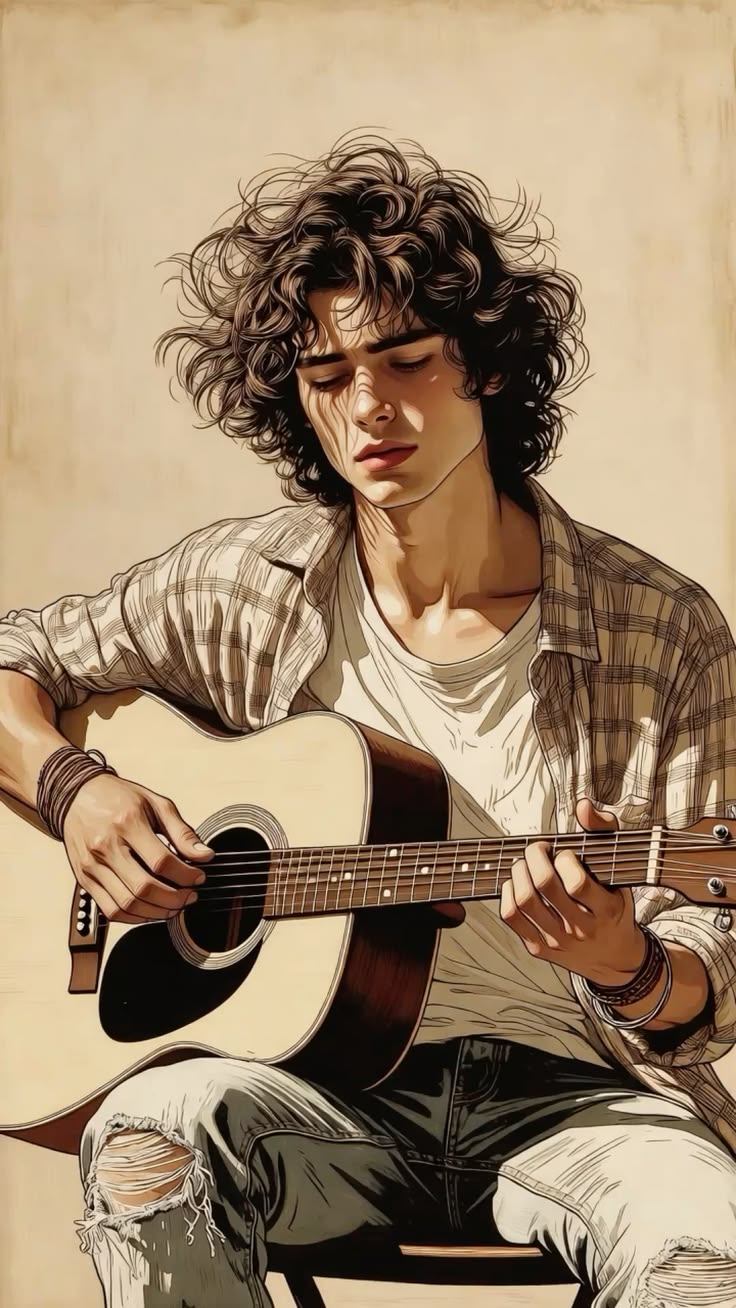
Guitar Art captures a quiet seated musician in a warm illustrated moment, with closed eyes, a lowered head, and an acoustic guitar resting naturally across the lap. Guitar Art composition keeps the full hair area, shoulders, torso, both arms, both hands, guitar body, long fretboard, upper thighs, ripped knees, and a narrow chair edge visible.
Why Guitar Art Creates a Powerful Vintage Music Mood
Guitar Art feels intimate because the pose is calm rather than staged. The torso stays mostly upright with a subtle natural lean, while the chin lowers slightly toward frame-left. Closed eyelids, relaxed brows, and softly resting lips suggest a musician absorbed in sound, giving the scene a peaceful emotional focus without a camera-facing expression.
Guitar Art depends on accurate hand contact. The right wrist bends gently as individual fingers meet the strings beside the sound hole for soft strumming or finger-picking. The left wrist wraps beneath the fretboard and curved fingers press separate strings in a realistic chord position. Clear knuckles, natural finger lengths, and believable wrist rotation protect the musical credibility.
Guitar Art instrument is the main foreground prop in Guitar Art. A pale natural-wood top, dark brown body depth, black teardrop pickguard, circular sound hole, fine concentric rings, bridge, saddle, metal strings, frets, and small markers create rich visual detail. The rounded body is partly cropped at frame-left, and the long neck exits naturally at frame-right.
Guitar Art uses warm clothing for a relaxed editorial character. A loose beige, cream, and muted taupe plaid overshirt hangs open over a simple off-white shirt. Fine grid lines bend with fabric folds, sleeve gathers, and cuff wrinkles. Dark distressed jeans bring stronger contrast, while large knee rips reveal dense cream fibers, hanging threads, and irregular shredded edges.
Guitar Art keeps body identity natural inside the reference pose. Shoulder width, arm size, torso volume, waist feel, and overall build remain consistent with the mapped person rather than becoming muscular or fashion-model slim. The illustrated face also preserves individual proportions, including brow shape, nose structure, lip volume, jaw width, chin form, cheek volume, forehead, and hairline.
Guitar Art uses detailed hair treatment for decorative movement. The person’s actual hairstyle identity remains intact, but the rendering uses flowing ink contours, overlapping strand groups, fine flyaways, deep interior shadows, and warm brown highlight ribbons. Dense hair detail frames the cleaner face and directs attention toward the lowered eyes and softly illuminated facial planes.
Refined Light and Detail for Guitar Art
Guitar Art uses crisp dark-brown and black contour lines with fine cross-hatching and controlled sketch marks. Soft cel-painted skin shading sits beneath the linework, supported by amber bounce light, cream highlights, and rich brown shadows. This balance keeps the result clearly illustrated while retaining precise anatomy and a refined graphic-novel finish.
A golden upper-left light source gives Guitar Art its luminous vintage atmosphere. Warm bloom touches the forehead, nose bridge, nose tip, upper cheek, lips, chin, neck, collarbones, shoulder edges, forearms, knuckles, and fingers. Select hair strands, the left shoulder, guitar edge, and hand contours receive radiant cream-gold rim separation without forming an artificial halo.
The background of Guitar Art remains deliberately quiet. A warm aged cream or light beige plaster-paper field surrounds the musician with faint vertical marks, subtle stains, edge wear, and gentle mottling. Empty space above the hair and around both upper corners prevents visual crowding and allows the detailed linework of the figure to remain dominant.
Guitar Art benefits from high texture density in selected areas. Hair contains repeated curved strands, plaid fabric carries distorted grid lines, guitar strings and frets remain individually readable, and torn denim shows layered threads and fibers. The face stays comparatively smooth and clean so identity, closed-eye emotion, and warm facial lighting remain easy to read.
The crop is essential to Guitar Art because the narrow vertical frame must still show the complete musical relationship between body and instrument. The head sits in the upper third, the guitar crosses the middle, and thighs with ripped knees fill the lower third. Guitar Art avoids extra zoom so neither the face nor guitar overwhelms the carefully balanced seated composition.
By combining precise anatomy with decorative linework, Guitar Art creates a calm visual story of concentration and sound. Guitar Art remains warm, detailed, and emotionally restrained, allowing the musician’s identity, seated posture, instrument, and gentle expression to carry the scene. Guitar Art finishes as a polished vintage music illustration with rich texture and clear focal balance.
[[[ Exact Reference Reconstruction Prompt
Exact Reference Reading
Reference posture: sitting. The subject is seated on a simple chair or stool, proven by the visible bent thighs, separated knees, lower torso resting between the legs, relaxed seated weight balance, and acoustic guitar supported horizontally across the lap. The torso is mostly upright with a soft forward/downward head tilt. The right forearm rests naturally over the guitar body while the right hand reaches the strings near the sound hole; the left arm extends diagonally toward frame-right with the left hand gripping the guitar neck and pressing the fretboard.
Reconstruct the MAIN REFERENCE with identity replacement only. Preserve the exact single-character composition, seated guitarist pose, downward head angle, closed-eye expression, guitar placement, hand positions, body scale, outfit, cream background, warm illustrated lighting, detailed line-art rendering, canvas ratio, crop, and soft vintage mood.
Do not zoom in. Preserve the same visible head, full hair area, shoulders, torso, both arms, both hands, complete guitar body, long fretboard, upper thighs, ripped knees, and chair edge.
Identity Lock
Preserve the uploaded person’s real facial identity with maximum face accuracy. Replace the reference face completely with the uploaded person while keeping exact facial proportions, eye shape and spacing, nose shape, lips, jawline, chin, cheek structure, forehead, head shape, hairline, hairstyle, beard status, skin tone, age impression, and body identity.
Preserve PERSON SOURCE natural body build, shoulder width, arm size, torso size, waist feel, height impression, and overall body identity inside the exact MAIN REFERENCE seated pose.
Never paste a raw selfie face. Rebuild the uploaded person’s identity completely in the same refined hand-drawn digital illustration style as MAIN REFERENCE. Adapt the identity to the exact downward head angle, closed eyes, peaceful expression, warm light direction, facial shadows, sharp ink contours, soft painted skin, and vintage color grade.
Do not copy PERSON SOURCE pose, smile, expression, clothes, background, camera, or lighting.
Character Position Map
Exact character count: 1 person only.
Single central guitarist: place the subject exactly in the center of the vertical canvas. Hair occupies the upper-center region with generous cream background above and around it. Face sits in the upper-middle, slightly left of the vertical centerline. Shoulders extend broadly across the middle width.
The guitar body fills the middle-left and lower-middle area. Its rounded left body is partially cropped by the left canvas edge. The circular sound hole sits near center-left. The guitar neck crosses horizontally with a slight upward diagonal through the middle-right and exits/crops at the right edge.
The seated torso occupies center. Both thighs fill the lower half. The left knee appears at lower-left with a large distressed rip; the right knee appears at lower-right with another distressed rip. Preserve the narrow dark chair/stool edge near bottom-center.
Do not move the subject upward, enlarge the face, reduce the guitar, or crop away the knees.
Reference Pose Map
1. Single central portrait: seated acoustic guitarist in a relaxed playing pose. Torso upright with a subtle natural lean. Head tilted downward and slightly toward frame-left. Chin gently lowered. Eyes fully closed. Brows relaxed. Lips softly closed or naturally relaxed. Expression peaceful, introspective, emotionally absorbed in music.
Right shoulder drops naturally toward the guitar. Right elbow extends toward frame-left. Right forearm lies across the upper guitar body. Right wrist bends softly; fingers hover/contact the strings directly beside the sound hole in a gentle finger-picking or soft strumming position.
Left shoulder remains relaxed. Left forearm extends diagonally downward/right toward the guitar neck. Left wrist wraps naturally below the fretboard. Fingers individually curve over the strings in a realistic chord position.
Legs are spread naturally in a seated stance, both knees bent. The guitar rests firmly across the lap and upper thighs.
Preserve this exact pose geometry. Never use PERSON SOURCE pose. Do not make the subject look at the camera, smile broadly, stand, lean backward, raise the guitar, or change the hand positions.
Style and Medium Lock
Create a high-detail hand-drawn digital illustration, refined ink-and-color graphic novel portrait, vintage editorial music artwork, delicate pen linework with softly painted warm shading.
Use crisp dark-brown and black contour lines, fine cross-hatching, controlled sketch marks, detailed hair strand loops, fabric fold lines, guitar wood contours, hand anatomy lines, and distressed denim fibers.
Combine the line drawing with smooth warm cel-painted skin shading, soft cream highlights, rich brown shadows, subtle amber bounce light, and restrained painterly gradients.
The result must remain clearly illustrated, not photographic. Preserve the MAIN REFERENCE balance of precise anatomy and decorative flowing linework.
Do not convert to anime, watercolor, oil painting, pencil-only sketch, 3D render, or realistic photography.
Face and Hair Accuracy Lock
Match PERSON SOURCE face identity while preserving the exact MAIN REFERENCE face scale and head tilt. Maintain accurate eye width and spacing even with closed eyelids, brow shape, nose bridge and nostril structure, lip volume, philtrum, jaw width, chin shape, cheek volume, forehead proportions, ear placement, and neck transition.
Preserve PERSON SOURCE hairstyle identity and hairline, but render the hair with the MAIN REFERENCE’s highly detailed flowing ink-line treatment. Use dense curved strand groups, overlapping loops, fine flyaway hairs, deep dark interior shadows, warm brown edge highlights, and glossy illustrated shine.
Do not automatically give the person the reference model’s curly hair if PERSON SOURCE has a different hairstyle. Identity hair belongs to PERSON SOURCE; rendering language belongs to MAIN REFERENCE.
Body, Ratio, and Crop Lock
Preserve the exact narrow vertical portrait ratio, approximately 9:16. Maintain the same natural medium/full seated framing.
No excessive zoom. No head-and-shoulders crop. No hidden guitar. No missing knees.
Preserve the reference subject scale: head and hair in the upper third, guitar across the middle, thighs and ripped jeans occupying the lower third.
Keep the same margin above the hair and the same cream negative space at both upper corners.
Preserve PERSON SOURCE natural body identity. Do not make the shoulders wider, waist slimmer, arms muscular, legs longer, or body fashion-model-like.
Outfit Lock
Use only MAIN REFERENCE clothing.
Outer layer: loose beige, cream, and muted taupe plaid/checkered overshirt with an open front, relaxed collar, rolled or gathered sleeves, thin dark grid lines, detailed folds, cuff wrinkles, and soft fabric drape.
Inner layer: simple off-white/cream relaxed scoop-neck or loose crew-neck T-shirt, lightly wrinkled across chest and abdomen.
Lower body: black and cream two-tone/distressed jeans with strong illustrated contrast, large torn knee sections, visible cream fabric/fibers, hanging threads, shredded denim edges, layered rip texture, and natural seated folds.
Wrists: multiple thin dark leather/cord bracelets stacked around both wrists exactly in the reference styling.
Do not use PERSON SOURCE clothes.
Guitar and Hand Contact Lock
Preserve the large acoustic guitar exactly as the main foreground prop.
Use a warm pale natural-wood guitar top, dark brown side/body depth, large black teardrop pickguard, circular sound hole with multiple fine concentric rings, dark fretboard, visible metal strings, individual frets, small fret markers, bridge, saddle, and realistic body curvature.
The guitar body must dominate center-left and remain partially cropped at frame-left. The neck must extend across the full middle-right and crop naturally at the right edge.
Preserve correct hand-to-guitar contact. Right fingers interact with the strings near the sound hole. Left fingers press individual strings against the fretboard.
Hands must be anatomically correct, with five fingers per hand, natural knuckle structure, correct finger length, believable wrist rotation, and no merged fingers.
Scene and Background Lock
Background is a minimal warm aged cream / light beige plaster-paper field.
Preserve faint vertical wall marks, soft paper stains, subtle darker edge wear, very light mottling, and a delicate vintage parchment texture.
No furniture details except the tiny visible chair/stool edge beneath the subject. No plants, stage, microphone, studio equipment, windows, outdoor scenery, source-photo background, or decorative objects.
Maintain the calm uncluttered negative space around the upper head and shoulders.
Strong Glow, Bloom, and Highlight Lock
Preserve and strengthen the MAIN REFERENCE’s warm illustrated illumination using strong cinematic glow, visible bloom, radiant rim light, glowing backlight, luminous highlights, and soft golden haze while staying within the refined illustration medium.
Create a clearly visible warm golden glow from upper-left/front-left. Place luminous highlights across the forehead, nose bridge, nose tip, upper cheek, lips, chin, neck center, collarbones, shoulder edges, forearms, knuckles, and fingers.
Use radiant cream-gold rim light around selected hair curls/strands, left shoulder, forearm, guitar body edge, and hand contours.
The guitar top must carry a broad soft golden shine. The sound-hole rim and strings should have tiny luminous highlights. Hair requires glossy warm brown highlight ribbons.
Keep the background softly blooming around the upper head without creating a halo circle.
Never output flat or weak lighting.
Vibrant Color and Highlight Lock
Preserve the warm color balance: creamy beige background, golden tan skin, deep chocolate-brown/black hair shadows, warm cream shirt, taupe plaid overshirt, pale natural guitar wood, dark brown guitar sides, black pickguard, black-and-cream distressed jeans.
Use vivid but elegant warmth, bright clean highlights, deep controlled shadows, strong facial color separation, glossy hair, luminous skin, rich guitar wood contrast, and crisp dark linework.
Highlight zones: upper-left background bloom, hair edge shine, forehead and nose light, cheek highlight, neck and collarbone glow, forearm shine, knuckle highlights, guitar top shine, string glints, fret highlights, and ripped-denim fiber highlights.
Do not make the artwork dull, gray, muddy, faded, washed-out, or low contrast.
Typography and Text Lock
No text, no name, no caption, no logo, no typography. Preserve the clean illustrated portrait composition.
Density and Texture Lock
Preserve high line-detail density in the hair, plaid overshirt, hands, guitar strings, fretboard, jeans, and torn knee fibers.
Hair must contain many overlapping curved strand lines. Plaid fabric must retain repeated grid lines and fold distortion. Guitar strings and frets must remain individually readable. Denim rips must contain dense hanging threads and irregular torn fibers.
Keep the face comparatively cleaner and smoother so identity remains the main visual focus.
9-Zone Audit
TL: warm empty cream background and subtle vintage texture preserved.
TC: hair crown, flyaway strands, and upper negative space preserved.
TR: cream background and outer hair/shoulder contour preserved.
ML: right arm, bracelets, plaid sleeve, and guitar body edge preserved.
MC: identity-accurate closed-eye face, neck, shirt, sound hole, and playing hand preserved.
MR: plaid shoulder, left hand, fretboard, strings, and right-edge guitar-neck crop preserved.
BL: large pale guitar body and left ripped knee preserved.
BC: seated lower torso, dark jeans, chair edge, and natural leg separation preserved.
BR: right thigh, distressed knee fibers, bracelets, and lower crop preserved.
Verify exactly 1 character, exact central position, exact seated pose, downward head angle, closed eyes, same guitar placement, correct hands, natural PERSON SOURCE body, same outfit, exact vertical ratio, no excessive zoom, warm cream background, strong golden glow, luminous highlights, rich warm colors, and high illustration detail.
Bad Output Mistakes
Do not zoom into the face. Do not crop out the guitar body, guitar neck, hands, or ripped knees. Do not make the subject standing. Do not copy PERSON SOURCE pose. Do not make the subject camera-facing or broadly smiling. Do not give random curly hair if it conflicts with PERSON SOURCE identity. Do not create a photorealistic portrait. Do not simplify guitar strings or hand contact. Do not remove the plaid pattern, bracelets, distressed jeans, or vintage cream background. Do not weaken the glow, hair shine, skin highlights, or guitar shine. Do not make the body slimmer, taller, muscular, or model-like.
Negative Prompt
wrong count, wrong position, same pose/view/angle repeated, copied source pose, missing character, extra character, shifted character, weak glow, missing bloom/rim light, flat lighting, dull colors, faded colors, muddy colors, low contrast, missing highlights, wrong face, identity mismatch, pasted selfie face, weak resemblance, wrong body, muscular body, slim model body, wrong ratio, wrong crop, excessive zoom, face too large, missing guitar, small guitar, wrong guitar position, broken guitar,
missing strings, wrong fretboard, wrong hand contact, wrong chord hand, wrong hands, wrong fingers, extra fingers, fused fingers, bad anatomy, source clothes, source background, wrong hairstyle identity, open eyes, camera gaze, broad smile, standing pose, anime, photorealistic photo, 3D render, watercolor, oil painting, simplified style, wrong typography, wrong name, unwanted text, missing details, low density, plastic skin, blurry face, watermark, logo, AI artifacts. ]]]
Prompt Features Explanation:
Guitar Art presents a beautifully illustrated concept centered on a single seated musician in a calm and emotionally expressive environment. The overall composition focuses on creating a timeless artistic scene where music, posture, lighting, and illustration techniques work together to communicate peace, concentration, and creativity. Rather than relying on dramatic movement or exaggerated emotion, the visual strength comes from subtle expression, balanced composition, and refined artistic craftsmanship.
The main subject is a single boy positioned carefully in the center of the composition. Every element is arranged to ensure that the viewer’s attention naturally flows toward the musician without unnecessary distractions. The figure occupies a comfortable amount of space within the vertical frame, allowing both the character and the instrument to remain equally important throughout the artwork.
Facial expression plays one of the most significant roles in this concept. The eyes remain gently closed while the head tilts naturally downward. Relaxed eyebrows, softly resting lips, and calm facial muscles communicate a deep emotional connection with music rather than interaction with the viewer. This peaceful expression creates an intimate atmosphere that feels personal and reflective.
Body language reinforces the emotional tone. The subject sits comfortably with relaxed shoulders and a naturally upright torso. There is no exaggerated pose or dramatic movement. Instead, the body appears balanced and believable, allowing viewers to feel as though they are quietly observing a genuine musical moment.
The acoustic guitar becomes the dominant foreground object and is integrated naturally into the seated pose. Resting comfortably across the lap, it creates a visual bridge between the upper and lower portions of the composition. Every visible detail of the instrument contributes to realism, including the smooth wooden surface, circular sound hole, bridge, strings, fretboard, frets, and elegant body contours.
Hand positioning receives exceptional attention throughout the concept. One hand gently interacts with the strings while the opposite hand presses the fretboard in a realistic playing position. Finger placement follows believable musical technique, adding authenticity that musicians and art enthusiasts alike can appreciate.
Clothing contributes significantly to the relaxed editorial appearance. The loose plaid overshirt introduces texture through intersecting grid patterns and naturally flowing folds. Beneath it, the simple light-colored shirt creates visual balance while allowing the patterned outer layer to remain visually interesting without becoming overwhelming.
The distressed denim introduces stronger contrast within the lower portion of the artwork. Large torn knee sections reveal textured fabric fibers and layered threads, adding handcrafted realism while maintaining the relaxed lifestyle aesthetic.
Hair rendering represents another major artistic highlight. Rather than appearing flat, individual strand groups flow naturally around the head using elegant linework and carefully layered highlights. Fine flyaway strands, darker interior shadows, and warm reflective highlights provide movement while preserving the individual’s natural hairstyle identity.
Lighting defines the emotional atmosphere of the composition. A warm golden light softly illuminates the face, shoulders, neck, hands, and guitar from the upper left direction. These highlights create depth while maintaining a gentle visual mood. Rich shadows balance the brighter areas without making the artwork feel dark or heavy.
The background intentionally remains minimal. A warm cream paper-like surface with subtle texture surrounds the musician, ensuring the detailed illustration remains the central visual attraction. Gentle imperfections such as faint stains and soft aging marks contribute to the vintage editorial appearance without distracting from the figure.
Artistic style combines detailed ink illustration with carefully painted color application. Crisp contour lines establish structure while smooth shading softens transitions across skin, fabric, and wood surfaces. This combination creates a sophisticated graphic novel appearance that feels handcrafted and premium.
Composition is carefully balanced from top to bottom. The head occupies the upper third, the guitar stretches across the center, and the seated legs complete the lower portion of the artwork. This arrangement keeps every important visual element visible while maintaining comfortable negative space around the subject.
Texture density varies intentionally throughout the illustration. Hair, clothing, guitar details, and denim fibers receive intricate treatment while facial skin remains comparatively clean. This selective detail guides the viewer’s attention naturally toward facial identity and emotional expression.
Warm earth tones dominate the color palette. Cream backgrounds, beige fabrics, golden skin tones, rich brown shadows, natural wood finishes, and deep black accents combine to create a timeless vintage atmosphere. The restrained palette allows every illuminated highlight to appear more luminous and visually satisfying.
This creative concept works exceptionally well for editorial artwork, music-themed publications, personal illustrations, portfolio displays, wall décor, album-inspired artwork, storytelling projects, social media graphics, artistic branding, greeting cards, posters, and creative presentations. Its balanced composition and emotionally quiet atmosphere make it suitable for audiences who appreciate refined illustration, music culture, and timeless visual storytelling.
Overall, Guitar Art combines realistic anatomy, elegant illustration techniques, sophisticated lighting, authentic musical details, balanced composition, and warm vintage aesthetics into a highly polished creative concept. Every component contributes toward producing an artwork that feels emotionally engaging, visually harmonious, and artistically memorable while celebrating the peaceful relationship between a musician and their instrument.
Internal Link:
“https://prompt.mahantababu.com/“
External DoFollow Link:
“https://en.wikipedia.org/wiki/Artificial_intelligence“
Incoming Link:
“https://prompt.mahantababu.com/guitar-art/“